

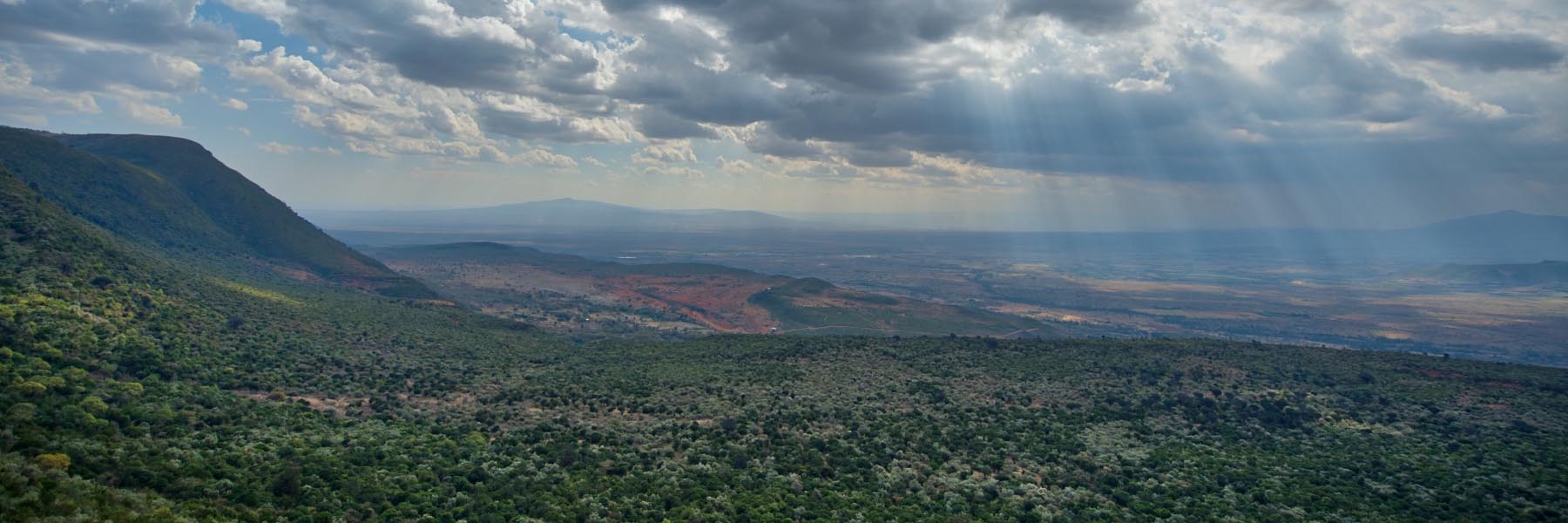
The Great Rift Valley Kenya is one of the most well-known rift valley systems on earth. It is a geological and geographical feature that stretches from Lebanon to Mozambique. Much of it falls in Kenya where it has split the country into two parts.

The valley contains the world’s finest lakes, mountains, and plains. To experience a fascinating topographical feature of Kenya, a visit here cannot be missed. This system runs 6000 km and has become a distinguishing mark of Kenya. The valley is magnificent, showcasing spectacular scenery of lakes, mountains, and savannahs.
However, the Great Rift Valley also has an equally intriguing history that makes it the humankind’s ancestral homeland today.
What is the Great Rift Valley?
The Great Rift Valley is a series of valleys that cuts through much of eastern Africa and part of southeastern Asia. It refers to a massive land depression, that was formed approximately twenty million years ago. It occurred due to two parallel fault lines that pulled apart.
The steep walls of the valley rise about 2000 meters high in some places. Most parts of the valley are 30 to 100 kilometers wide. The Great Rift Valley has some of Africa’s most spectacular scenery including lakes, as well as active and extinct volcanoes.

In Eastern Africa, the valley is divided into the western and eastern branches. The western branch of the valley runs along the eastern border of Zaire. Most of the section is covered by the earth’s deepest lakes, Lake Tanganyika and Lake Nyasa.
On the other hand, the valley’s eastern branch runs through the central parts of Ethiopia, Kenya, and Tanzania. Some of the earliest known human remains have been found here. The valley stretches to such a scale that it is clearly visible in photographs of the earth when taken from space.

In Kenya, the north of Nairobi is where the valley is the deepest. Also scattered along the length of the Great Rift Valley of Kenya are seven lakes. As these lakes do not have an outlet to the sea, they tend to remain shallow and have a high mineral content. As a result, all but two of the Rift valley lakes are undrinkable.
The formation of the Great Rift Valley
Scientists explain the formation of the Great Rift Valley with the help of plate tectonic theory. According to this theory, the earth’s outer shell consists of about 30 rigid sections of rock called plates.
Movement along the boundary between two plates is about 1 to 10 centimeters a year. As plates move, the boundaries may collide, spread apart, or slide alongside one another. Such movements along with erosion and volcanic activity have also helped form the valley.
It has been speculated that the rift will soon become deep enough to host a new ocean that will separate Eastern Africa from the rest of the African continent.
Exploration of the Great Rift Valley
The Royal Geographical Society sent an expedition to the valley region in search of the Nile’s source. Austrian geologist Eduard Suess formulated his theory of the Great Rift Valley with the help of detailed reports during that trip. In 1891, he published a paper that attributed Syria and Malawi’s geology and structural geography to interconnected movements between the Earth.
Following the years, John Walter Gregory, a British explorer, embarked on his explorations to East Africa. He confirmed the interpretations of Suess who stated the tectonic origin of this valley. But Gregory also recognized similarities between the African Rift Valley and the geology of the Red Sea. He proposed that these landscapes are connected.
Later, Gregory mentioned these findings in his books where he also gave the modern term for the Great Rift Valley which is still used for the entire African Rift. He connected the Great Rift Valley to the tectonic movements of the Earth.
The historical influence of the Great Rift Valley
The most recent immigrants of this region were the ancestors of the Maasai. They dominated the majority parts of the region and its surroundings and lived on both sides of the valley for centuries before the Europeans arrived. After the European settlement, for much of the colonial era, the Maasai were forced out of their former grazing land. They were confined to the southern reserve which is now called Amboseli National Park.

Today, most of the Maasai people have returned to the valley. They are at their most conservative and traditional in Southern Kenya.
Places to see in the Great Rift Valley
Some of central Kenya’s wildest and most picturesque sceneries can be found at the Great Rift Valley. There are exceptional lakes, twisting roads, majestic mountains, and diverse wildlife. Here are some of the top places you must see while visiting the Great Rift Valley:
Lake Baringo
Lake Baringo is a peaceful and beautiful oasis, which boasts 470 species of birds. According to the sun’s position and the state of the sky, the lake showcases a range of colors from coral to purple.

Lake Bogoria
Lake Bogoria has saline and alkaline water and has become a favored feeding ground for a number of lesser flamingos. From the lakeshore, animals such as greater kudu, hyena, buffalo, impala, zebra, Grant’s gazelle, and more can be easily spotted.

Lake Elmenteita
Lake Elmenteita is a shallow soda lake and offers various off-beaten destinations. The lake is surrounded by the broken caldera walls of extinct volcanoes that resemble a human figure. In East Africa, Elmenteita is the only breeding ground for the great white pelican which nests on a few rock islands of the lake.

Lake Naivasha
Lake Naivasha is one of the freshwater lakes in the Rift. It is a picturesque lake, standing still at the backdrop of a mountain while islands of papyrus float on its water. It boasts un-spoilt savanna and plenty of local wildlife. Hippos, giraffes, waterbucks, and zebras are the most frequent visitors of Lake Nakuru.

Lake Nakuru National Park
Lake Nakuru National Park is one of the main attractions for massive flocks of lesser and greater flamingos. These pink birds thrive on Lake Nakuru’s algae-rich and alkaline waters. Aside from various bird species, animals such as endangered rhinos, Rothschild giraffe, lion, leopard, hyena, and others can be observed.

Hell’s Gate National Park
The Hell’s Gate National Park is named after its intense geothermal activities within its boundaries. It boasts spectacular vistas of the valley including towering cliffs, gorges, scrub-clad volcanoes, and geothermal steam. The most common animals frequenting Hell’s Gate National Park are African buffalo, zebra, Thompson’s gazelle, and more.

The Great Rift Valley remains a complicated system but an interesting geological wonder. Just like any other marvel, the Great Rift Valley should be on top of the list while visiting Kenya.
If you loved reading this story, then subscribe to our blog here (it will ask to verify your email) to get inspiring travel stories and trivia delivered to your email. Stories about wildlife trivia, cultural experiences, curated luxury hotel lists, underrated places to travel, polar journeys and much more.